


Integrating POS and EInvoice with ERP – Automating Sales, Inventory, Finance, and Accounting
As part of their digital transformation journey, many businesses have implemented standalone systems for POS, sales management, inventory management, e-invoicing, and accounting.
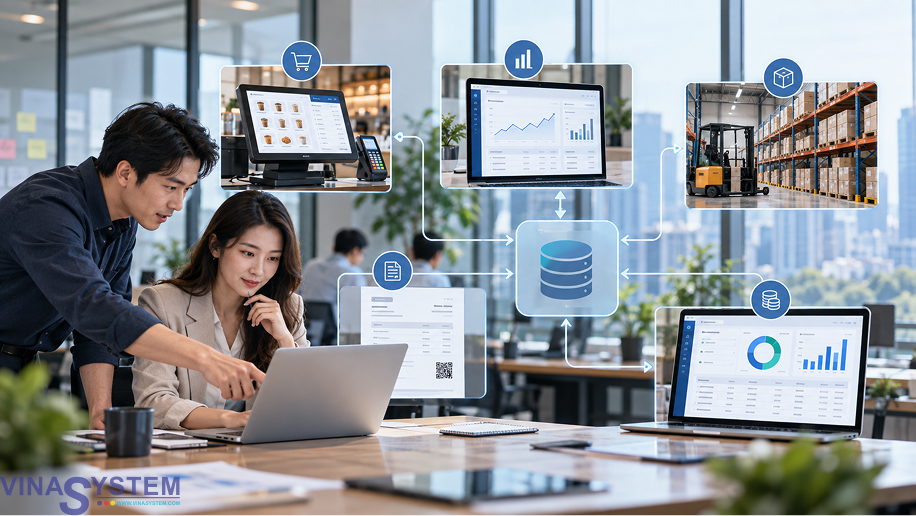
In practice, a single sales transaction may pass through multiple systems—from POS and inventory to invoicing and accounting. When these systems operate independently, businesses can easily face inventory discrepancies, duplicate data entry, time-consuming reconciliation, and a lack of up-to-date information for decision-making.
According to SAP, these are signs that the current operational platform may be becoming a barrier to business growth and scalability. At this stage, the challenge is no longer simply about connecting different software systems. It is about creating a seamless data flow across the entire business process.

A Unified Process from Sales Transactions to Financial Reporting
Based on integration architectures that Vina System has successfully implemented, an effective connected operating model should ensure that the data generated from each transaction can be used consistently throughout the entire business process lifecycle.

Seamless Operations When POS and ERP Are Integrated
Once a transaction is confirmed, relevant information—including products, customers, inventory, revenue, and documents—is accurately transferred to the appropriate systems without relying on repetitive manual data entry.
This helps businesses reduce errors, shorten processing times, and, more importantly, maintain a reliable source of data for management and decision-making.
SAP Business One is designed around this integrated approach by connecting key functions such as purchasing, inventory, and finance within a single platform. This enables departments to work with consistent, real-time data across the organization.
To evaluate whether an integrated operating model is truly effective, businesses should typically consider three key principles:
- Data should be captured in the system best suited to the business process where it originates, while minimizing manual re-entry.
- Systems should share or synchronize core business data based on a single, standardized source of truth.
- Transaction statuses should be updated consistently across sales, inventory, invoicing, payment, and finance.
Why Choose SAP Business One for POS Integration?
SAP Business One Solution is well suited for POS integration because it enables businesses to centrally manage core processes such as sales, inventory, purchasing, finance, accounting, and reporting within a single platform. When POS data is synchronized with SAP Business One, businesses can automatically update inventory levels, revenue, accounts receivable, and related transactions without repeatedly entering the same information across multiple systems.
In addition, SAP Business One supports multi-warehouse and multi-branch operations, centralized product data, and customer receivables management. This makes it particularly suitable for businesses operating multiple stores or expanding their retail chains. Its integration capabilities also allow businesses to flexibly connect SAP Business One with external systems such as POS solutions, e-invoicing platforms, e-commerce systems, and other specialized applications.
As a result, SAP Business One serves not merely as a back-end data repository for POS systems, but as a centralized business management platform that helps organizations gain greater operational control, minimize data inconsistencies, and access timely information for better decision-making.

SAP Business One Brings Disconnected Data Together
How many steps does your business currently need to take to move a transaction from the POS system all the way to financial reporting?
Reviewing the complete flow across POS, sales, inventory, e-invoicing, and accounting can help businesses identify areas where manual data entry, complex reconciliation, or data inconsistencies are still occurring.
From there, businesses can develop an appropriate integration roadmap to automate processes, improve data accuracy, and optimize overall operational efficiency.
With more than 20 years of experience in SAP Business One implementation, Vina System supports businesses throughout the entire journey—from understanding requirements and assessing existing systems to identifying process bottlenecks and designing a POS–ERP integration architecture that fits their actual operating model.
Our approach goes beyond software implementation. We aim to help businesses build an integrated management platform that is scalable, future-ready, and capable of generating long-term value from their data.
Contact us today to speak directly with the Vina System team and register for a SAP Business One demo. Instead of evaluating the solution only in theory, you can see firsthand how the system addresses real-world business management challenges before making your decision.
CONTACT US FOR A FREE CONSULTATION NOW
- Hotline: (+84) 903 952 648
- Email: [email protected]
- Website: vinasystem.vn